The Post-Pandemic Pivot
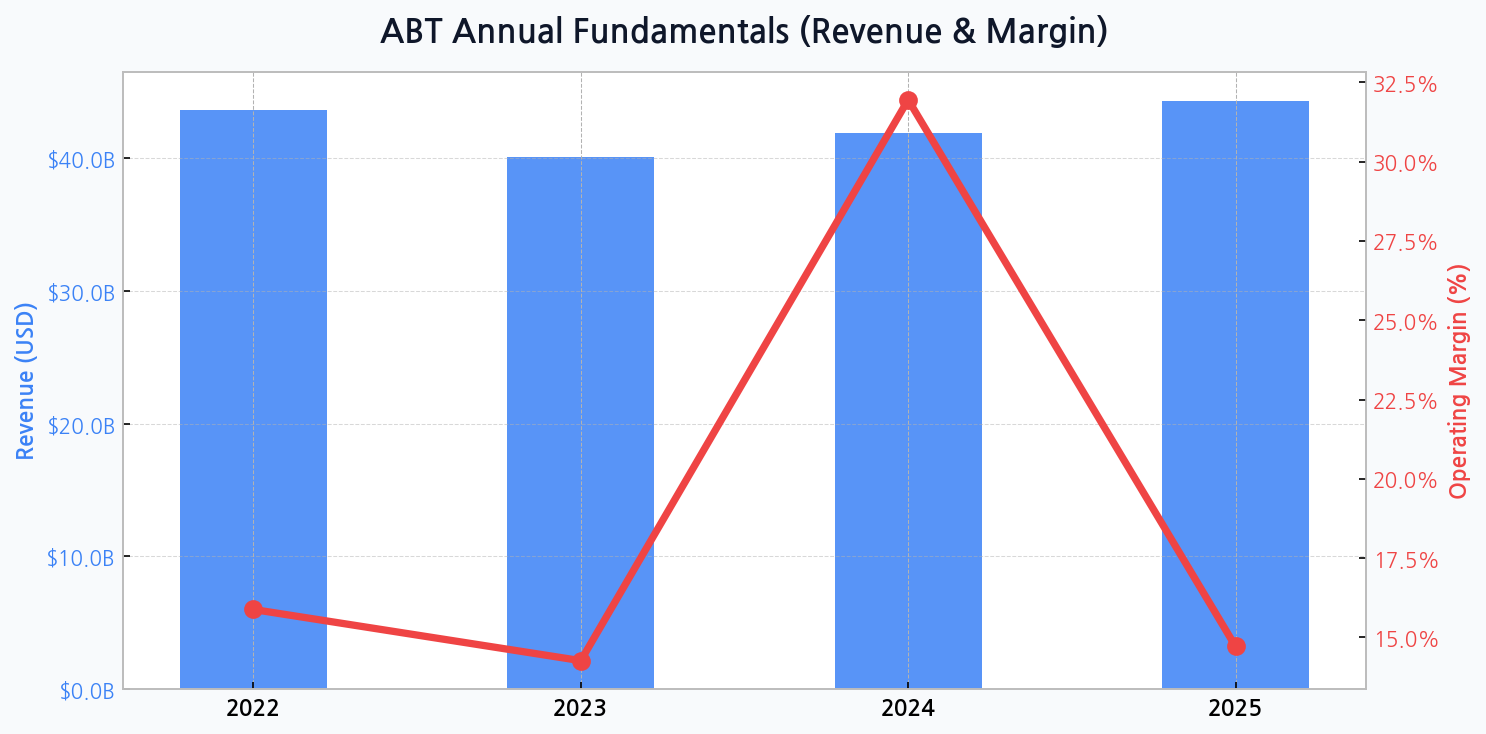
Abbott's financial narrative is one of strategic recalibration. The decline in revenue from $43.7B in 2022 to $40.1B in 2023 directly reflects the tapering demand for COVID-19 diagnostics. This shift forces a greater reliance on the company's core, diversified portfolio.
Unleashing the CGM Growth Engine
The undisputed star of Abbott's portfolio is the FreeStyle Libre, a leader in the continuous glucose monitoring (CGM) market. This device is not just a product but an ecosystem, driving recurring revenue and creating a substantial competitive moat against rivals.
| Company | Key Product | Market Position | Competitive Moat |
|---|---|---|---|
| Abbott (ABT) | FreeStyle Libre | Leader (Volume) | Affordability & Accessibility |
| Dexcom (DXCM) | G-Series | Leader (Revenue) | High-End Features & Integration |
| Medtronic (MDT) | Guardian | Challenger | Insulin Pump Integration |
DIFF Insight: Abbott's strategy with Libre focuses on market penetration through a lower price point, fundamentally expanding the user base beyond traditional intensive-insulin users. This volume-driven approach builds a loyal customer base that is difficult for premium-priced competitors to erode, creating long-term, sticky revenue streams.
The Margin Volatility Puzzle
While revenue is projected to recover to $42.0B in 2024 and $44.3B in 2025, operating margin presents a more erratic picture. After dipping to 14.3% in 2023, the forecast shows an anomalous spike to 31.9% in 2024 before settling at 14.7% in 2025. This suggests potential one-off gains or significant cost restructuring.
[Chart] Total Assets (Bar) & Debt Ratio (Line) for ABT
[Chart] A visualization of Abbott's annual revenue and the corresponding, more volatile, operating margin from 2022 through 2025.
Diversification as a Bedrock of Stability
Beyond diagnostics, Abbott's strength lies in its diversified revenue streams. Its four core segments—Medical Devices, Diagnostics, Nutrition, and Established Pharmaceuticals—provide a powerful buffer against downturns in any single area, ensuring operational resilience.
| Business Segment | Est. Revenue Contribution | Key Growth Drivers |
|---|---|---|
| Medical Devices | ~ 40% | FreeStyle Libre, MitraClip, Amplatzer |
| Diagnostics | ~ 25% | Core Laboratory, Molecular, Point of Care |
| Nutrition | ~ 20% | Ensure, Glucerna, Similac |
| Established Pharma | ~ 15% | Emerging Market Sales |
DIFF Insight: The Medical Devices segment, anchored by CGM, is clearly the primary growth engine, offsetting the normalization in the Diagnostics division. This internal balance is critical for investor confidence, proving the company's ability to thrive beyond the temporary windfall from pandemic-related products.
A Fortifying Financial Position
A key positive trend is Abbott's commitment to deleveraging its balance sheet. The company's debt ratio shows a consistent and healthy decline, projected to fall from 50.4% in 2022 to a much more manageable 39.1% by 2025. This strategic debt reduction enhances financial flexibility for future acquisitions or R&D investments.
"Abbott's capital allocation strategy is shifting from pandemic response to long-term innovation. We're seeing a clear focus on reinforcing the balance sheet while doubling down on platforms like Libre that define the future of personalized healthcare."
Looming Threats on the Horizon
Despite its strengths, Abbott is not immune to external pressures. The healthcare landscape is fraught with challenges, from intense pricing pressure in medical devices to the constant threat of regulatory shifts that could impact product approvals or market access.
| Risk Factor | Probability | Potential Impact | Mitigation Strategy |
|---|---|---|---|
| CGM Competition | High | Medium | Continuous innovation, cost leadership |
| Regulatory Hurdles | Medium | High | Proactive engagement with FDA/EMA |
| Supply Chain Disruption | Medium | Medium | Geographic diversification of manufacturing |
DIFF Insight: While competition is a constant, the most potent risk lies in the regulatory domain. An unexpected delay or rejection of a next-generation Libre product could cede critical ground to competitors and disrupt the company's primary growth narrative, making proactive regulatory strategy paramount.
Key Catalysts for Future Growth
- Pipeline Innovation: Continued advancements in the Libre platform, including dual-sensor technology for glucose and ketones.
- Emerging Market Expansion: Deepening penetration of its pharmaceutical and nutrition products in high-growth regions.
- Strategic Tuck-in Acquisitions: Utilizing its strengthening balance sheet to acquire complementary technologies in cardiology and diagnostics.